

Writing a Research Proposal for a PhD Scholarship is not that hard, but if you don’t know how to do it properly, then stay with me as i show you how.
Let’s be honest for a second. The dream of landing a fully funded PhD scholarship abroad is what keeps many Nigerian graduates awake at night.
Whether you are eyeing the UK, Canada, or the US, the goal is the same: to level up your career and maybe, just maybe, “Japa” to an environment with 24/7 electricity and better funding.
But here is the hard truth: Your grades alone won’t get you there.
You might have a First Class or a strong 2:1 from UNILAG or UI, but if your PhD research proposal is weak, your application will end up in the rejection pile faster than you can say “ASUU Strike.”
Writing a research proposal isn’t “beans.” It requires technical skill, academic writing prowess, and the ability to sell an idea. But don’t panic.
In this guide, we will break down exactly how to write a proposal that doesn’t just look good but actually wins scholarships.
READ ALSO: Vanier Canada Graduate Scholarship: $50,000/Year for PhDs
Table of Contents
What Exactly is a PhD Research Proposal?
Think of your research proposal as a business plan. But instead of selling a product to investors for Naira, you are selling an idea to a university for funding.
A PhD research proposal is a structured document that outlines:
- What you want to investigate.
- Why it is important (The Value).
- How you plan to do it (The Methodology).
For Nigerian students, this is your chance to show international supervisors that despite the challenges in our local education system, you have the intellectual capacity to contribute to global knowledge.
Note: Most scholarships (like Commonwealth, PTDF, or DAAD) use the proposal to judge your critical thinking skills. They don’t expect the proposal to be perfect, but they expect it to be promising.
READ ALSO: Top 7 Universities in UK Accepting HND for Masters
Step-by-Step: How to Structure Your Proposal
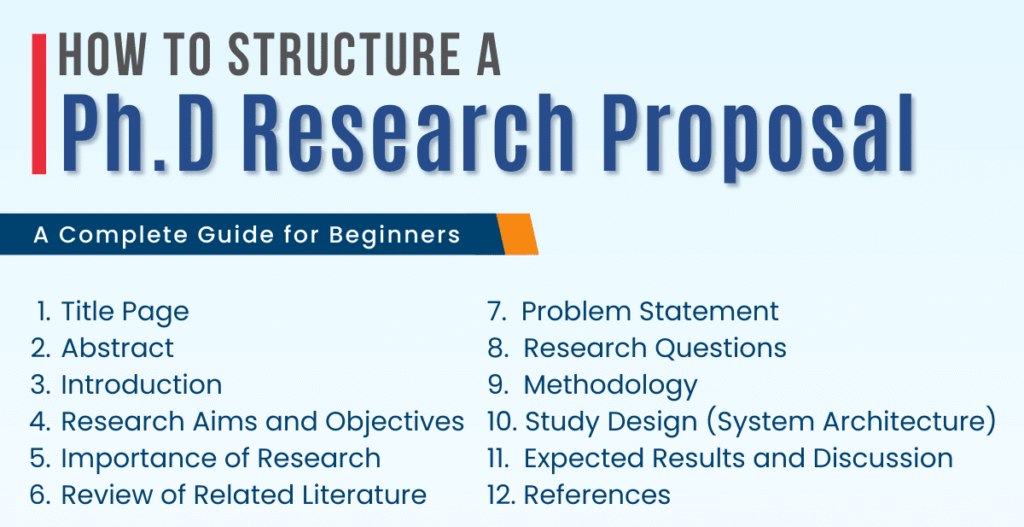
A standard proposal ranges from 1,500 to 3,000 words. Here is the blueprint you need to follow to secure that supervisor approval.
1. The Title: Your First Impression
Your title shouldn’t look like a full paragraph. Keep it concise, descriptive, and catchy. It should contain the key variables of your study.
- Bad: A study on how banks in Nigeria are failing customers.
- Good: The Impact of Digital Banking Failures on Customer Trust in the Nigerian FinTech Sector: A Case Study of Lagos State.
2. Introduction and Background
This is where you hook the reader. Start broad and narrow it down.
- The Hook: Introduce the general subject area.
- The Context: Briefly mention what is currently happening in that field.
- The Gap: This is crucial. What is missing? For example, “While many studies focus on FinTech in Europe, there is limited data on how unreliable internet infrastructure affects digital banking adoption in West Africa.”
3. Problem Statement & Research Questions
This is the heart of your proposal. If you can’t clearly define the problem, you don’t have a research topic.
- Problem Statement: Clearly state the issue. (e.g., “Despite the rise of mobile money, rural farmers in Enugu still rely on cash, limiting their access to credit.”)
- Research Questions: List 3-4 specific questions your study will answer.
4. Smart Research Topic Selection
Many students fail here because they pick topics that are too broad. Research topic selection requires precision. Don’t try to solve all of Nigeria’s economic problems in one PhD. Pick one specific aspect.
- Tip: Look for recent papers (last 3-5 years) and check their “Recommendations for Future Research” section. That is where the gold is.
5. The Literature Review
This section proves you have read books. But don’t just list authors. You need to synthesize the information.
- Show that you know the major theories in your field.
- Critique existing studies.
- Identify the “Gap.”
- SEO Tip: A strong literature review demonstrates that you are ready for high-level academic writing.
6. Methodology (The “How”)
This is often the deal-breaker. Supervisors want to know if your plan is realistic.
- Research Design: Will it be Qualitative (Interviews), Quantitative (Surveys/Data), or Mixed Methods?
- Data Collection: Who are you studying? (e.g., “500 undergraduates in Federal Universities”).
- Data Analysis: What tools will you use? (SPSS, NVivo, Python, R).
Pro Tip for Nigerians: Be realistic. If your methodology requires high-tech lab equipment that isn’t easily available, explain how you will access it or if the scholarship university provides it.
7. Timeline and Budget
PhD research is a marathon, not a sprint.
- Timeline: Break your 3-4 years into phases (e.g., Year 1: Coursework & Lit Review, Year 2: Data Collection, etc.).
- Budget: Even if applying for a fully funded scholarship, showing a projected budget proves you understand the costs involved.
READ ALSO: Commonwealth Shared Scholarship: Participating UK Universities
Getting Supervisor Approval for Your Proposal
Before you even submit your application to the university, you often need a supervisor to say, “Yes, I will mentor this student.”
- Do Your Homework: Visit the university website. Read the profiles of the professors. Find one whose research interests align with your PhD research proposal.
- The Email: Keep it professional.
- Subject: Prospective PhD Student: Research Proposal on [Topic].
- Body: Introduce yourself, mention their recent work (flattery works!), and attach your proposal.
- Persistence: Professors are busy. If they don’t reply in 2 weeks, send a polite reminder.
SEE ALSO: List of PhD Scholarships for Nigerian Students
Common Mistakes To Avoid in Your Applications
Avoid these errors if you don’t want your application to end up in the trash bin.
- Plagiarism: This is a capital offense abroad. Do not copy-paste from Google. Use tools like Turnitin or Grammarly to check your work.
- Vague Titles: “A study on Poverty” is too broad. Be specific.
- Ignoring Formatting Rules: If they ask for APA 7th edition, don’t give them MLA. If they ask for 2,000 words, don’t write 5,000.
- Poor Grammar: Bad English signals that you will struggle with the thesis. Proofread your work or pay a professional editor.
Disclaimer:
Important: Creating a PhD research proposal takes time and effort. While looking for scholarships, please be careful. There are many fake scholarship sites promising “instant visas” for a fee.
- Never pay money to apply for a legitimate scholarship (except for official application fees to the university).
- Always verify the scholarship on the official university or government website.
- If it sounds too good to be true (e.g., “No GRE, No IELTS, No Proposal, 100% Cash”), it is likely a scam. Shine your eyes!
READ ALSO: Chevening Scholarship 2026: Secrets to Winning from Nigeria
FAQs on Research Proposal for a PhD Scholarship
How long should a PhD research proposal be?
Typically, a research proposal should be between 1,500 and 3,000 words. However, always check the specific requirements of the university or scholarship board you are applying to.
Can I change my research topic after getting the admission?
Yes, in most cases. Your proposal is a roadmap, not a binding contract. Once you start your program, your supervisor might help you refine or pivot your topic based on new data or resources.
Do I need a finished Master’s thesis to write a PhD proposal?
Not necessarily, but having a Master’s degree is usually a prerequisite for a PhD.
You can adapt your Master’s thesis topic for your PhD, but you must expand it significantly to demonstrate a higher level of complexity and originality.
What if I don’t have a supervisor yet?
Some universities allows you to apply without a supervisor, and they will assign one to you if you are admitted. However, securing supervisor approval beforehand significantly boosts your chances of acceptance and funding.
READ ALSO: NNPC/Chevron Scholarship 2026: Application Guide & Past Questions
In Summary
Writing a PhD research proposal is hard work. It involves late nights, plenty of coffee (or Garri), and reading dozens of academic papers. But remember, this document is your passport to a global career.
Don’t let the fear of rejection stop you. The difference between a candidate who gets the scholarship and one who doesn’t is often the clarity and confidence of their proposal.
Take your time, follow the structure above, and ensure your passion for the subject shines through.
Are you currently working on your proposal? Drop a comment below with your topic or any challenges you are facing. Let’s rub minds together!




Leave a Comment