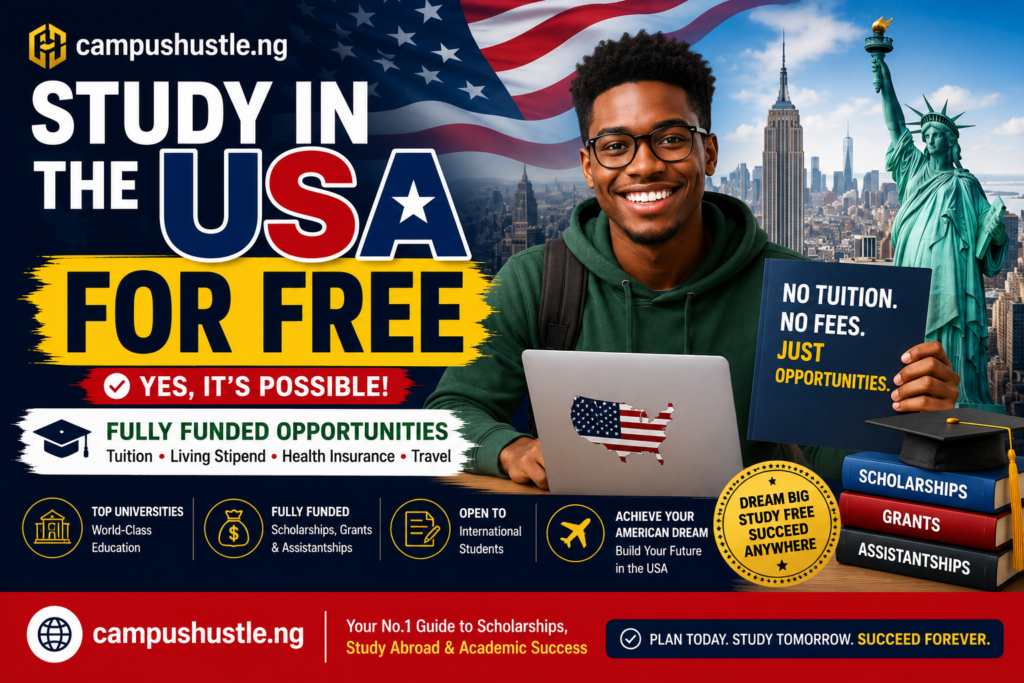
America. The land of Harvard, MIT, Stanford, and Yale. The land of billion-dollar university endowments, world-class research facilities, and campuses that look like the ones you see in every Hollywood movie you have ever watched.
And the price tag to match all of that. US university tuition for international undergraduates can run from $30,000 to $80,000 per year, not including accommodation, feeding, health insurance, and books. For a 4-year degree, you are looking at $120,000 to $320,000. That is hundreds of millions of Naira.
But here is what most Nigerians do not know, and this is the entire point of this article:
Many top American universities offer full or near-full scholarships to exceptional international students. Including Nigerians. And we are not talking about rare unicorn opportunities, we are talking about structured, well-funded programs that exist precisely to attract brilliant students from countries like Nigeria.
The key is knowing which universities have the money and the will to fund international undergraduates, how to build a competitive application profile, and how to navigate a process that is quite different from Nigerian university admissions.
In this guide, we will break all of that down for you, the scholarships, the universities, the requirements, the timeline, and the strategies that give Nigerian students the best possible chance of studying in America for free.
READ ALSO: Canada Masters Scholarships for Nigerian Students (10 Best Options in 2026)
Table of Contents
How US Undergraduate Scholarships Work (The System Explained)
This is fundamentally different from how scholarships work for Masters or PhD programs in the US, so read this carefully.
For US undergraduate admissions, financial aid (the American term for scholarships and grants) is administered by the university itself, not by a central government body. Each university has its own endowment, its own financial aid budget, and its own policies for how it distributes aid to international students.
There are two types of US university financial aid relevant to Nigerian students:
1. Merit Aid Awarded based on academic achievement, your grades, test scores, and overall academic profile. Merit aid is competitive, universities use it to attract the strongest students.
2. Need-Based Aid Awarded based on your family’s demonstrated financial need, how much your family can realistically afford to pay. Need-based aid at top US universities can be enormous, sometimes covering 100% of costs for families earning below certain thresholds.
The most powerful situation for Nigerian students is when a university offers need-based aid to international students, because Nigerian family incomes are almost always low by US standards, which means the demonstrated financial need is typically very high, which means the aid award is very large.
The important thing to understand is that applying for financial aid and applying for admission are separate processes, though they happen at the same time and through the same university portal.
READ ALSO: 5 Fully Funded Undergraduate Scholarships in USA for Nigerians
Need-Blind vs Need-Aware Admissions — The Crucial Distinction
This is the most important concept in US college financial aid for international students.
Need-Blind Admissions (for International Students) The university evaluates your academic application without considering whether you need financial aid. If you are admitted, they then assess your financial need separately and commit to meeting 100% of it. You are admitted purely on academic merit, and then the money follows.
For international students, very few US universities are need-blind. The ones that are need-blind for international students are the ones you should target most aggressively.
Need-Aware Admissions (for International Students) The university considers whether you are applying for financial aid as part of its admissions decision. If two equally qualified students apply (one needing full funding and one paying full fees) the paying student has an advantage. This makes it harder (not impossible) for international students needing full funding to be admitted.
Most US universities are need-aware for international students. This does not mean you cannot get funding, it means the competition is steeper.
Top US Universities That Fully Fund International Undergraduates
Need-Blind Universities for International Students (The Priority List)
Only a handful of US universities are fully need-blind for international undergraduate applicants. These are your primary targets, because admission and full funding are decoupled.
Harvard University Harvard has one of the largest university endowments in the world ($50+ billion) and meets 100% of demonstrated financial need for all admitted students, including internationals. Harvard is need-blind for international students.
What does this mean in practice? If your family’s income is low by US standards (which virtually every Nigerian family’s income is), Harvard’s financial aid could cover 100% of tuition, room, board, and even flights home. Students from families earning less than $85,000/year often pay nothing. Students from families earning $85,000–$150,000 pay on a sliding scale. Above that, aid reduces.
Nigerian families: most would qualify for very substantial or complete coverage.
Yale University Like Harvard, Yale meets 100% of demonstrated financial need for all admitted international students. Yale’s financial aid is generous and comprehensive, covering tuition, housing, meals, books, and personal expenses.
Yale is need-blind for international applicants, meaning your financial need does not affect your admissions decision.
Princeton University Princeton’s financial aid is arguably the most generous of any university in the world. They replaced loans with grants, meaning the aid Princeton gives you does not need to be repaid. Princeton is need-blind for international students and meets 100% of need.
Princeton students from Nigerian families with typical income levels would likely receive full or near-full grants covering all university costs.
MIT (Massachusetts Institute of Technology) MIT is need-blind for all applicants including international students. They meet 100% of demonstrated financial need. For a Nigerian family, MIT’s need analysis would typically result in a very substantial grant award.
MIT is primarily STEM-focused, Engineering, Computer Science, Physics, Chemistry, Biology, Architecture, Economics. If your interests are in these areas, MIT should be at the top of your list.
Amherst College Amherst is a top-ranked liberal arts college, smaller than Harvard or MIT, but equally rigorous and equally well-funded. Amherst is need-blind for international students and meets 100% of demonstrated need.
Liberal arts colleges offer a broader education than specialised universities, combining sciences, humanities, social sciences, and arts in an integrated curriculum.
Need-Aware Universities With Generous International Aid
These universities are not need-blind for international students, but have significant financial aid budgets for international applicants and regularly award near-full or full scholarships to exceptional students from countries like Nigeria.
Columbia University (New York) Columbia meets 100% of demonstrated need for all admitted students and has recently been increasing its international financial aid budget. While technically need-aware for internationals, Columbia has committed to meeting full need for admitted international students who qualify.
University of Pennsylvania (UPenn) Penn meets 100% of demonstrated need for admitted students. Penn’s financial aid is comprehensive, though the admissions process for need-full international applicants is competitive.
Duke University Duke has a strong international financial aid program and meets 100% of demonstrated financial need for admitted students. Duke’s scholarship for international students is generous and merit considerations are strong.
Dartmouth College Dartmouth meets 100% of demonstrated need for admitted students. Smaller Ivy League college with strong financial aid and a close-knit community.
Williams College Like Amherst, Williams is a top liberal arts college with exceptional financial aid — it meets 100% of demonstrated need and has been expanding its international recruitment.
Bowdoin College, Middlebury College, Pomona College, Davidson College These are top liberal arts colleges with strong financial aid programs for international students. Smaller and less well-known than the Ivy League, but academically excellent and often more accessible for strong international applicants.
READ ALSO: DAAD Scholarship Germany: Choosing the Right EPOS Course
Other Scholarship Programs for Nigerian Undergraduate Students
Beyond university financial aid, a small number of scholarship programs specifically fund international undergraduates at US universities:
Mastercard Foundation Scholars Program
The Mastercard Foundation partners with selected US universities to fund African students, covering full tuition, accommodation, feeding, travel, and personal expenses.
Partner universities have included the University of California Berkeley (UCB), Arizona State University (ASU), and others. The Mastercard Foundation scholar program is highly competitive and specifically targets students from Sub-Saharan Africa with academic excellence and demonstrated leadership potential.
Check the Mastercard Foundation website (mastercardfdn.org) for current partner institutions and application cycles.
Davis United World College Scholars Program
The Davis UWC Scholars Program funds students who have attended United World College (UWC) institutions (international high schools in various countries) to attend US universities. If you attended a UWC high school (there is no UWC currently in Nigeria, but some Nigerian students have attended UWC schools in other countries through scholarship), you qualify for Davis Scholars funding at over 100 US university partners.
QuestBridge National College Match
QuestBridge is a US-based program that connects high-achieving, low-income students with top US universities offering full scholarships. International students can apply for the QuestBridge College Prep Scholars program, which, while not directly awarding scholarships, provides recognition that US universities respond to, and connects applicants to universities that actively recruit QuestBridge scholars.
What US Universities Look for in International Applicants
This is critical, US undergraduate admissions is holistic. Unlike Nigerian university admission (which is primarily JAMB/Post-UTME score-based), US universities evaluate:
Academic Excellence Strong grades in challenging subjects. If your school offered WAEC/NECO with A grades across science and mathematics subjects, that demonstrates academic excellence. If your school offered any international qualifications (A-Levels, IB), those are also valued.
Standardised Test Scores SAT or ACT scores (see dedicated section below). Many schools are now test-optional, but strong scores strengthen an application.
Extracurricular Activities What have you done outside of class? Sports, arts, community service, entrepreneurship, student government, scientific research, writing, music, US universities want to see students who are engaged, passionate, and doing things beyond just studying.
Leadership and Impact Evidence that you have made a difference, started a project, led a team, solved a problem, contributed to your community. Even small-scale leadership in a Nigerian context (founding a school club, organising a community clean-up, starting a small business) counts.
Essays Personal essays that reveal who you are as a person, your values, your experiences, your voice. The US college essay is one of the most important and most distinctive elements of the application.
Letters of Recommendation From teachers and counsellors who know you academically and personally. Strong, specific, detailed recommendations carry significant weight.
Demonstrated Interest Attending virtual information sessions, campus visits (if possible), emailing admissions officers with thoughtful questions, US universities track demonstrated interest as a signal that you will enrol if admitted.
READ ALSO: Erasmus Mundus Scholarship: How to Study in 3 European Countries
The Application Process — Step-by-Step
Step 1: Research Universities (Grade 10/11 — 2 Years Before) Start building your list of US universities in your 10th or 11th year of secondary school. Research need-blind schools, financial aid policies, academic programs, and campus culture.
Step 2: Build Your Profile (Throughout Secondary School)
- Maintain excellent grades in challenging subjects
- Take SAT/ACT preparation seriously (starting in Grade 10)
- Build meaningful extracurricular activities, not a random list, but 2–3 areas of genuine passion and commitment
- Take leadership roles where possible
Step 3: Prepare for Standardised Tests (Grade 11) Register for and take the SAT or ACT. Many Nigerian students take the SAT through the College Board, it is available at testing centres in Lagos, Abuja, and other major cities.
Step 4: Build Your College List (Grade 12, September) By the start of your final year, have a list of 10–15 universities:
- 3–4 Reach schools (Harvard, MIT, Yale, Princeton, very selective)
- 5–6 Match schools (schools where your profile matches their typical admitted student)
- 3–4 Safety schools (schools where you are confident of admission and aid)
Step 5: Write Your Essays (Grade 12, August–October) The Common App essay (650 words) is your main personal statement. Additionally, most universities require supplemental essays — shorter essays specific to each school.
Step 6: Request Letters of Recommendation (Grade 12, September) Ask 2–3 teachers and your school counsellor for recommendation letters. Give them at least 4–6 weeks and provide them with a summary of your activities and your university list.
Step 7: Complete Applications Most US applications go through the Common App (commonapp.org) — a centralised platform where you fill in one main application and submit it to multiple universities. Each university has additional questions within the Common App.
Key deadlines:
- Early Decision / Early Action: November 1 or November 15 (for binding or non-binding early admission, results come in December)
- Regular Decision: January 1 or January 15 (results come in March/April)
Step 8: Submit Financial Aid Applications Complete the CSS Profile (for most private universities, $16 per additional school after the first) and/or FAFSA (for public universities). These applications require detailed information about your family’s finances.
Step 9: Compare Offers and Accept By April 1, most decisions are out. Compare financial aid award letters carefully. The acceptance deadline is typically May 1 (National Candidates Reply Date).
Standardised Tests — SAT, ACT, and AP
SAT (Scholastic Assessment Test) The SAT is administered by the College Board and has two sections: Evidence-Based Reading and Writing (800 points maximum) and Mathematics (800 points maximum). Total maximum: 1600.
A competitive SAT score for top US universities (Harvard, MIT, Yale) is typically 1500–1580. For slightly less selective schools, 1350–1450 is competitive.
Nigerian students can register for the SAT at the College Board website (collegeboard.org). Testing centres exist in Lagos (American International School of Lagos and others), Abuja, and other cities.
ACT (American College Testing) An alternative to the SAT. Covers English, Mathematics, Reading, and Science. Scored on a scale of 1–36. A competitive score for top schools is 34–36.
Some students perform better on ACT than SAT, take practice tests for both and choose accordingly.
Test-Optional Schools Many US universities are now test-optional, meaning you can choose whether to submit SAT/ACT scores. If your scores are strong (above the school’s median), submit them. If not, apply test-optional and strengthen other parts of your application.
AP (Advanced Placement) Exams If your school offers AP courses or if you can take AP exams independently, doing so and scoring 4–5 on AP exams in subjects relevant to your intended major (AP Calculus, AP Physics, AP Chemistry, AP English) demonstrates college-level academic ability and strengthens your application significantly.
How to Write a US College Essay That Wins
The 650-word Common App essay is unlike any writing Nigerian students have done before. It is not an academic essay. It is not a motivation letter. It is a personal narrative, a story about who you are.
What the essay is NOT:
- A summary of your achievements and activities (that is what the activity list is for)
- A statement of academic goals (that is what the “Why This School” supplement is for)
- A generic reflection on wanting to “contribute to society”
What the essay IS: A specific, personal, authentic story that reveals something meaningful about your character, your values, your perspective, or your experience, something that helps the admissions reader understand who you are as a human being beyond your grades and test scores.
What works for Nigerian applicants specifically: Your Nigerian experience (growing up in Lagos traffic, navigating power cuts while studying for exams, the texture of your family life, the specific challenges and joys of your upbringing) is genuinely interesting to US admissions readers who read thousands of essays from American students.
Do not try to sound “American” in your essay. Do not erase your Nigerian identity. Your specific, honest, vivid Nigerian experience is your competitive advantage.
The structure that works:
- Open with a specific, concrete scene or moment (not “Growing up in Nigeria, I always…”)
- Develop the story with specific sensory details
- Reveal what this experience shows about you — your values, your thinking, your growth
- End with a forward-looking connection to your college goals
Common Mistakes Nigerian Applicants Make
Applying only to top-10 universities Many Nigerian students know Harvard, MIT, and Yale, and apply only to those, getting rejected everywhere. Cast a wider net. Apply to excellent schools at multiple selectivity levels.
Not applying for financial aid because it seems “too complicated” The CSS Profile and financial aid process are intimidating but not impossible. Every Nigerian family that qualifies for substantial aid and does not apply is leaving life-changing money on the table.
Writing essays that list achievements “I am the best student in my school, I won five awards, I am the school prefect, I want to study Medicine to help my country.” This is not a compelling essay. It is a list. Write a story.
Ignoring application deadlines US application deadlines are real and non-negotiable. November 1 means November 1 — not November 5. Late applications are not reviewed.
Not preparing for standardised tests seriously The SAT/ACT can be significantly improved with structured preparation. Khan Academy offers free SAT prep. Investing serious time in test preparation pays off enormously.
Applying without extracurricular activities US universities expect to see sustained engagement outside the classroom. If you are in SS1 or SS2 and reading this, start building meaningful extracurricular involvement now — not in SS3.
READ ALSO: Get Your Scholarship Past Questions & Answers PDF
FAQs on How to Study in the USA for Free
Can Nigerian students really get full scholarships to Harvard, MIT, or Yale? Yes. Nigerian students have attended Harvard, MIT, Yale, Princeton, and other top US universities on full financial aid. It requires exceptional academic performance, strong standardised test scores, compelling essays, and a compelling profile, but it is not impossible.
Do I need to be rich to apply to US universities? No, in fact, the financial aid system is designed to make top US universities accessible to students from low-income families. If your family income is low by US standards (which applies to most Nigerian families), you may actually receive more aid than a middle-class American family.
What is the difference between a scholarship and financial aid in the US? In the US context, “financial aid” is the broader term that includes grants (money you do not repay), scholarships (merit-based awards), work-study (campus jobs), and loans. For international students, the relevant component is grants — free money you do not repay.
When should I start preparing for US university applications? Ideally in JSS3 or SS1, building your academic record, taking standardised tests, and developing extracurricular interests. The minimum viable preparation timeline is SS2 (beginning test prep, identifying target schools) with a strong SS3 application push.
Can I apply to US universities after completing SSCE without A-levels or IB? Yes, WAEC/NECO results are accepted by US universities as proof of secondary school completion. Strong scores in relevant subjects strengthen your application. However, A-level or IB qualifications, if available, can further strengthen your academic profile.
Is it harder to get financial aid as an international student? At need-blind schools (Harvard, MIT, Yale, Princeton, Amherst), no, you are evaluated purely on academic merit. At need-aware schools, applying for financial aid does make admission slightly more competitive for international students. This is why targeting need-blind schools with full financial aid is the strategic priority.
READ ALSO: Scholarship Interview Questions and How to Answer Them (With Examples)
In Summary
Studying in the USA for free as a Nigerian student is not a fantasy. It is a strategic goal that requires early preparation, a strong academic profile, a compelling application, and the courage to aim at opportunities that most Nigerian students assume are “not for people like me.”
The American university system (particularly at need-blind schools like Harvard, MIT, Yale, Princeton, and Amherst) is specifically designed to attract and fully fund exceptional students from around the world, regardless of their family’s financial situation.
Your Nigerian background, your specific experiences, your hustle, and your story are exactly what these universities want to read about. You just need to tell it right.
Your action plan:
- If you are in SS1/SS2: Start SAT prep, build extracurricular activities, maintain strong grades
- If you are in SS3: Identify your university list, start essays in August, register for SAT by October, begin CSS Profile in November
- If you have finished secondary school: Some US universities accept gap year students — research the options carefully
America is not just for children of diplomats and oil executives. It is for you.
Are you a secondary school student or recent graduate interested in applying to US universities? Drop your year of study and your intended field in the comments — we will help point you in the right direction.
Disclaimer: US university financial aid policies, scholarship amounts, and application requirements change annually. The financial aid programs described are based on publicly available information as of 2026 and should be verified on each university’s official financial aid website. Campus Hustle Nigeria is not affiliated with any US university and does not charge for guidance.