
You found the perfect scholarship. You meet every single requirement. Your CGPA is solid, your work experience is relevant, and your referees are ready.
But then you open the application portal and you see it:
“Please upload your Motivation Letter (maximum 1,000 words).”
And your brain goes blank.
You open Google. You find a sample. You change the name and submit it.
That is exactly why you are not winning.
The motivation letter, also called a Statement of Purpose (SOP), Letter of Motivation, or Personal Statement depending on the scholarship, is the single document that separates the shortlisted candidates from the rejected ones. Your CGPA gets you through the door. Your motivation letter decides if you get the seat.
In this guide, we are going to teach you how to write a motivation letter for a masters scholarship that actually wins, not just one that sounds nice.
We will show you the structure, the mistakes to avoid, the exact language to use, and we will give you a sample framework you can adapt for any scholarship, whether it is DAAD, Chevening, Fulbright, Commonwealth, Erasmus, or any other.
READ ALSO: Chevening Scholarship 2026: Secrets to Winning from Nigeria
Table of Contents
What is a Motivation Letter?
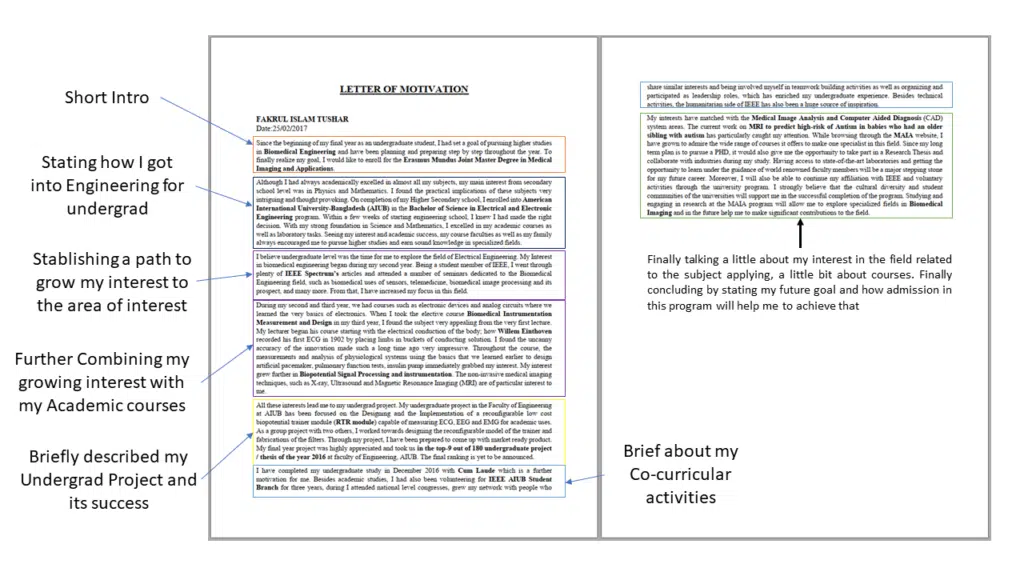
A motivation letter is a formal letter (usually between 500 and 1,500 words) that you submit as part of your scholarship or university application. It explains:
- Who you are (briefly — your background and identity)
- Why you want this specific scholarship or program
- What you have done that proves you are the right candidate
- What you plan to do with the education once you have it
Think of it as your pitch. In 1,000 words, you are convincing a committee of highly educated, experienced people that out of thousands of applicants, you are the one whose story, goals, and potential make them want to invest in your future.
That is not a small thing. That is a big thing. Treat it like one.
Motivation Letter vs Statement of Purpose vs Personal Statement
Different scholarships use different names for similar documents, and understanding the subtle differences helps you write the right thing.
Motivation Letter Most common in European scholarships (DAAD, Erasmus, Dutch Government, Swedish Institute). Slightly more personal in tone — it combines your academic and professional background with your personal drive and future goals. Usually 1 page (500–800 words) unless the scholarship specifies otherwise.
Statement of Purpose (SOP) More common in US university and scholarship applications (Fulbright, US universities). More academic and research-focused. Emphasises your intellectual interests, proposed area of study, and research plan. Usually 1–2 pages.
Personal Statement Used by UK scholarships (Chevening, Commonwealth) and some others. Most personal of the three — it can include life story, values, challenges overcome, and leadership narrative. Usually 500–1,000 words per essay question.
For the purposes of this guide, we will use “motivation letter” to cover all three, because the core principles are the same. When you know your scholarship’s specific requirements, you adjust accordingly.
What Scholarship Committees Are Really Looking For
Before you write a single word, you need to understand what the reader wants to see. Scholarship committees — whether it is the DAAD committee in Germany, the Fulbright panel in Abuja, or the Chevening committee at the British High Commission — are asking the same fundamental questions about every applicant:
1. Does this person have a clear purpose? Are they applying because they have a genuine goal, or are they just chasing any scholarship they can find? Committees can tell the difference immediately.
2. Are their goals relevant to what our scholarship is meant to achieve? DAAD is about German-Nigerian academic relations and development. Fulbright is about US-Nigeria exchange and leadership. Chevening is about future Nigerian leaders. Your letter must show you understand and align with the scholarship’s mission.
3. Can they do the work? Your academic background and experience must credibly demonstrate that you are capable of succeeding in a competitive international postgraduate program.
4. Will they make the most of this opportunity? Not just surviving the program — but using it, networking, contributing, and coming back to make an impact.
5. Are they authentic? Committee members read thousands of letters. They know generic from genuine within the first paragraph. Your letter must sound like a real human being with a real story, not a template filled in with your name.
The Structure That Wins (Step-by-Step Breakdown)
Here is the structure used by successful scholarship winners globally. This works for DAAD, Chevening, Fulbright, Commonwealth, Erasmus, Australia Awards, and most other competitive scholarships.
Paragraph 1: The Hook (The Opening) Start with a powerful, specific sentence that immediately establishes your purpose. Do not start with “My name is…” or “I am writing to apply for…”
Paragraph 2: Your Background and Journey Briefly explain who you are, what you studied, and what you have been doing professionally. Focus on what is directly relevant to the scholarship and your proposed field.
Paragraph 3: The Problem or Gap You Have Identified What problem have you witnessed, worked with, or researched that motivates your desire for further study? This is your “why” — the engine that drives the whole letter.
Paragraph 4: Why This Program and This Country Be specific. Why this particular course? Why this university or country? What does this program offer that you cannot get elsewhere? Mention specific modules, faculty, research centres, or methodologies.
Paragraph 5: Why This Scholarship Why are you applying for this specific scholarship and not just a regular visa? What does the scholarship’s values or network mean to you?
Paragraph 6: Your Return Plan and Impact What will you do after you graduate? Be concrete. Name a sector, an organisation, a region of Nigeria, or a specific project. Show them you are coming back with a plan.
Paragraph 7: Closing A confident, memorable closing sentence. Thank the committee. Reaffirm your commitment.
How to Write Each Section
The Hook — Your Opening Paragraph
This is the most important sentence you will write. The committee decides in the first 10 seconds whether your letter is worth reading carefully or skim-reading.
❌ Do NOT open like this: “My name is Chioma Okafor and I am a graduate of the University of Lagos where I studied Public Health. I am writing to apply for the DAAD Scholarship because I want to further my education in Germany.”
That is boring. That tells the committee nothing they cannot read in your CV. And it makes you sound like every other applicant.
✅ Open like this instead: “In 2023, a cholera outbreak in Borno State killed 43 people in three weeks — not because there was no treatment, but because there was no system to detect it early enough. As the field coordinator who arrived on the fourth day, I made a decision then: I would spend the rest of my career ensuring that Nigeria never loses lives to diseases we can prevent. That decision is why I am applying for the DAAD Development-Related Postgraduate Courses scholarship in Epidemiology and Public Health.”
See what happened there? In four sentences, you know exactly who this person is, what they have experienced, what drives them, and why they are applying. That letter gets read.
Your opening does not have to be about a dramatic event. It can be a realisation, a turning point, a conversation, a statistic that shocked you. But it must be specific, personal, and immediately relevant to your application.
Your Background — Keep It Tight
You have one paragraph — maybe two short ones — to summarise your academic and professional background. Be selective. Do not list everything on your CV. Choose the 3–4 most relevant experiences that directly support your application.
If you studied Biochemistry and you are applying for a scholarship in Public Health, connect the dots. Explain how your Biochemistry foundation prepared you for health systems work.
If you have published research, mention it. If you led a team, mention it. If you worked in a sector that directly relates to your proposed field, mention it prominently.
The Problem — Your Why
This is where most Nigerian applicants are the weakest. They describe their academic interests but not the specific problem or gap that drives them.
Ask yourself: “What have I seen, experienced, or researched in Nigeria that shows me there is a gap that my education abroad could help me fill?”
Your answer should be specific to Nigeria (or your immediate community). The more specific, the better.
❌ Weak: “Nigeria has poor healthcare infrastructure and I want to help improve it.”
✅ Strong: “Despite a growing network of Primary Health Care centres in Kebbi State, under-5 mortality remains 30% above the national average, largely due to the absence of trained health systems managers at the local government level. My three years as a Health Educator with a Kebbi State NGO have shown me that the gap is not just funding — it is management capacity. That is why I want to study Health Systems Management.”
Why This Program and Country
Do your research. Real research — not a Google search of “why study in Germany.”
- Visit the university’s website. Read the specific course curriculum. Identify 2–3 modules that directly address your research interest.
- Look at the faculty. Is there a professor whose research aligns with yours? Name them.
- What is unique about how this country approaches your field? Germany’s engineering rigour? Australia’s community health model? Canada’s multicultural policy framework?
Example: “The MSc in Environmental Governance at the University of Freiburg is particularly compelling because of its integration of EU environmental law frameworks with comparative studies from developing nations — a combination unavailable in any Nigerian institution. Furthermore, Professor [Name]’s work on community-led environmental monitoring in Sub-Saharan Africa directly mirrors the approach I intend to deploy in the Niger Delta upon my return.”
That level of specificity tells the committee you are serious.
Why This Scholarship
Every scholarship has a mission. State that you understand it and that you align with it.
- DAAD: Development-relevant study, return to contribute to your home country
- Chevening: Future Nigerian leaders with networking potential
- Fulbright: Mutual understanding between Nigeria and the US through educational exchange
- Commonwealth: Strengthening the Commonwealth through skilled professionals
- Erasmus: European academic collaboration and global citizenship
Mention the alumni network, the scholarship’s values, or a specific aspect of the program (like DAAD’s re-invitation program for former scholars) that resonates with you.
Your Return Plan
Be concrete. Vague return plans are the fastest way to raise red flags.
❌ Vague: “After completing my studies, I plan to return to Nigeria and use my knowledge to contribute to national development.”
✅ Concrete: “Upon returning to Nigeria, I will return to my current position at the Nigerian Institute for Medical Research (NIMR) in Lagos, where I have been working as a Research Associate. I intend to lead the establishment of a Molecular Epidemiology Unit, building on the research methodology I will acquire at Heidelberg. Within five years, I aim to publish peer-reviewed research on antibiotic resistance patterns in Nigerian hospitals — a field with virtually no published local data.”
Motivation Letter Sample Framework
Use this as your starting point. Replace every bracketed section with your specific details.
[Powerful opening sentence describing a specific moment, problem, or realisation that motivated your application.]
[One to two sentences connecting that opening to your decision to pursue this scholarship and this field of study.]
I hold a [degree] in [field] from [university], where I graduated with [result]. Since then, I have worked as a [role] at [organisation] for [X years], focusing specifically on [relevant aspect of your work]. [Add one specific achievement or project that directly demonstrates your competence in this field.]
During this time, I encountered a specific challenge that crystallised my desire for advanced study: [describe the specific problem or gap in Nigeria that motivates you]. Despite [context — existing efforts or infrastructure], [the gap remains because of a specific reason]. Addressing this gap requires [the specific skills or knowledge you will gain from this program].
The [Program Name] at [University Name] in [Country] is uniquely positioned to provide this training. I am particularly drawn to [specific module, research centre, or faculty member] because [specific reason tied to your career goals]. [Add one more specific detail about the program that you cannot get elsewhere.]
The [Scholarship Name] scholarship resonates deeply with me because of its commitment to [mention the scholarship’s mission or values]. I am committed to returning to Nigeria upon completion of my studies and [specific plan — role, organisation, project, or sector]. Within [timeframe], I aim to [specific measurable goal].
I am grateful for the opportunity to apply for this scholarship and am fully committed to representing both the values of the [Scholarship Name] program and the potential of Nigerian scholars on the global stage.
Power Words and Phrases That Work
Use these intentionally — not as fillers, but when they genuinely describe your experience:
- “I witnessed firsthand…” (shows direct experience)
- “This experience crystallised my decision to…” (shows turning point)
- “The gap I identified is…” (shows analytical thinking)
- “Upon returning to Nigeria, I will specifically…” (shows commitment)
- “Professor [Name]’s research on [topic] aligns directly with…” (shows research)
- “This program uniquely addresses…” (shows specificity)
- “My three years working on [X] have shown me that…” (shows experience)
Avoid overused buzzwords like: “passionate about,” “dynamic,” “team player,” “synergy,” “leverage” (unless in context), and “I have always dreamed of.”
Mistakes That Will Get You Rejected
Starting with your name or “I am writing to apply for…” The committee knows who you are and why you are writing. Get to the point.
Being vague about your field and goals “I want to study Business” is not a plan. “I want to study Supply Chain Management to address pharmaceutical distribution failures in Nigeria’s rural markets” is a plan.
Copying a template from the internet Committees can identify generic letters instantly. Worse, if two applicants submit the same template (which happens), both are immediately disqualified.
Ignoring the scholarship’s mission Writing a beautiful letter that says nothing about why THIS scholarship aligns with your goals shows a lack of research and respect for the programme.
Making it entirely about yourself Yes, it is about you. But the committee is asking: what will YOU do for Nigeria and for the world? If your entire letter is “I want, I need, I will benefit,” you have missed the point.
Grammar errors and typos Get at least two people to proofread it before you submit. A letter full of errors tells the committee you did not care enough to review your own work.
Exceeding the word limit If they say 800 words, do not submit 1,200 words. Exceeding the limit signals poor judgement and an inability to follow instructions.
How to Adapt Your Letter for Different Scholarships
The core of your letter (your story, your problem, your goals) stays the same across applications. What changes is the framing around the scholarship’s specific mission.
Create one master motivation letter that is approximately 1,200 words and includes all your key elements. Then, for each scholarship, adjust:
- The opening (if the scholarship has specific values, reference them early)
- The “Why this scholarship” paragraph (make it scholarship-specific every time)
- The word count (cut to fit the requirement)
- The tone (Chevening allows more personal storytelling; DAAD is more academic)
Save each version with the scholarship name in the filename so you do not accidentally submit the wrong version. It happens. Do not let it happen to you.
Final Checklist Before You Submit
Go through this list every single time before you hit submit:
- ☐ Does my opening immediately grab attention?
- ☐ Have I explained a specific problem in Nigeria that drives my goals?
- ☐ Have I mentioned the specific program, university, and why I chose them?
- ☐ Have I addressed the scholarship’s mission and why I align with it?
- ☐ Is my return plan concrete and specific?
- ☐ Is the letter within the required word count?
- ☐ Have I avoided clichés and generic language?
- ☐ Has at least one other person proofread it?
- ☐ Does the letter sound like me — authentic and specific?
- ☐ Have I removed all mentions of a different scholarship’s name? (This mistake happens more than you think)
FAQs
How long should a motivation letter be? Always follow the scholarship’s instructions. If no limit is given, aim for 800–1,000 words. For SOPs for US universities, 1–2 pages (single-spaced) is standard.
Should I use bullet points in my motivation letter? Generally no. A motivation letter should read as flowing paragraphs, not a list. It is a personal narrative, not a CV. Bullet points can be used sparingly in an SOP when listing specific research interests or course modules, but use them with caution.
Can I use the same letter for multiple scholarships? Your story stays the same, but you must customise at least the scholarship-specific sections for each application. Never submit an identical letter to two different scholarships — especially if one scholarship’s name is mentioned in the body.
Should I mention my weaknesses (like a low CGPA) in my motivation letter? Only if you have a compelling story that explains and reframes it. If your 2:2 was due to a documented health issue or family crisis that you have since overcome, addressing it briefly and then pivoting to your recovery and subsequent achievements can actually strengthen your application. Do not draw attention to weaknesses without a redemptive arc.
How formal should the tone be? Professional but human. This is not a legal document, but it is also not a WhatsApp message. Write the way you would speak at an important job interview — clear, confident, and direct.
READ ALSO: Australia Awards Scholarship for Nigerian Students (Full Guide)
In Summary
Your motivation letter is not a formality. It is the most human document in your entire application, the one place where the committee gets to meet you as a person, not just as a collection of grades and certificates.
The Nigerian students who win scholarships to Germany, the US, the UK, Australia, and Canada are not always the ones with the highest CGPA. They are the ones who tell the clearest story about why they need this scholarship, what they will do with it, and why they are coming back.
Write that story. Make it specific. Make it honest. Make it yours.
Start drafting today, even if the scholarship portal is not yet open. The earlier you start, the better the letter will be.
Do you want us to review a draft of your motivation letter? Drop it in the comments or contact us directly — we are happy to give feedback.
Disclaimer: This guide is for educational purposes. Scholarship requirements and specific instructions vary by programme. Always read the official guidelines for each scholarship you apply to before writing your motivation letter. Campus Hustle Nigeria does not charge for guidance and is not affiliated with any of the scholarship bodies mentioned.