
You finally landed your first foreign client. The work is done, the invoice is ready, and then the question hits you: how do you actually get paid?
This is where many Nigerian freelancers get stuck. Some options are not available in Nigeria, some charge high fees, and some platforms change their rules without much notice. This guide explains the main ways to receive international payments in Nigeria, how each one works, what to watch out for and how to choose the right option for your situation.
Quick answer: The main ways to receive international payments in Nigeria are Payoneer (common for Upwork and Fiverr payouts), foreign-currency account services that give you USD, GBP or EUR account details, direct bank transfers, and local payment gateways like Flutterwave for invoicing. The best choice depends on your client’s location, how they prefer to pay, and the fees you are willing to bear.
Important: Payment services, fees and availability for Nigeria change often. Always confirm current details on each provider’s official website before you sign up or give your account details to a client.
First, Understand How International Payments Work
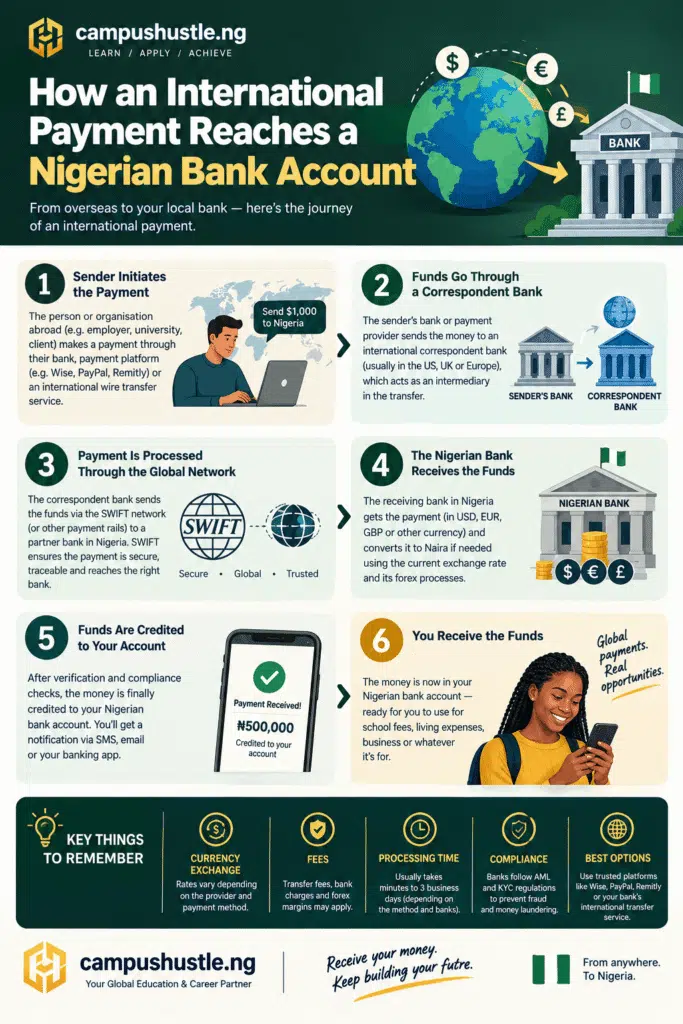
Before comparing options, it helps to know the basic route your money takes:
- Your client pays in a foreign currency (usually USD, GBP or EUR) using a bank, card or payment platform.
- A payment provider or bank receives it and holds it as a balance in your account.
- You withdraw to your Nigerian bank account, usually after conversion to naira, or hold the money in a foreign-currency balance.
At each step, you may pay fees. Typical costs include a fee for receiving, a currency conversion margin and a withdrawal fee. Smart freelancers watch all three, not just the advertised one.
Option 1: Payoneer
Payoneer is a global payments platform widely used by freelancers. Several marketplaces, including Upwork and Fiverr, support payouts through it, and it can give you receiving details to be paid directly by clients in some cases.
Pros:
- Common and trusted among freelancers and marketplaces
- Withdraws to local bank accounts in Nigeria
- Can receive payments from clients on supported platforms
Cons:
- Fees for receiving, withdrawing and converting currency can add up. Payoneer has updated its fee structure in the past, so check the current pricing page.
- Account verification can take time, and accounts are sometimes reviewed or limited if documents do not match
- Withdrawal speed depends on your bank
Tip: Withdraw in larger batches rather than many small amounts if the platform charges a fixed fee per withdrawal. This helps reduce fees as a share of your earnings.
Option 2: Wise
Wise is known for transparent fees and rates close to the mid-market exchange rate. According to Wise’s own help page on NGN transfers, people abroad can send naira to personal and business bank accounts in Nigeria, and the money usually arrives the same working day once Wise has received and converted the payment.
That means one practical use for Nigerians is simple: if your client has a Wise account, they may be able to pay you straight into your Nigerian bank account in naira. You need your full name, bank code and 10-digit account number.
Pros:
- Clear fee display before the client confirms the transfer
- Rates are usually fairer than many traditional bank transfers
- Your client can pay without you needing a special account
Cons:
- The ability to open and use a full Wise account depends on where you live. Do not assume you can get foreign account details as a resident of Nigeria. Check Wise’s current country availability.
- Your client has to be willing to use Wise
Option 3: USD, GBP and EUR Account Services for Nigerians
A newer set of fintech apps gives Nigerian freelancers account details (for example, a US routing and account number) so foreign clients can pay as if they were paying a local account. Examples frequently used by Nigerian freelancers include Grey and Cleva.
You can hold the dollars, convert them to naira, or withdraw to a Nigerian bank.
Pros:
- Clients can pay by ACH or wire in a familiar way
- You can hold foreign currency until you decide to convert
- Some allow withdrawals to Nigerian banks in naira
Cons:
- Fees vary: some charge on deposits, conversion or withdrawals
- These are private companies, so you should check licensing, reviews and support quality before depositing large amounts
- Features and fees change, so compare current terms
Safety checklist before using any new payment app:
- Is the company registered and clearly identified on its website?
- Does it describe how it holds customer funds?
- Do you see consistent recent reviews from real users, not only promotional posts?
- Can you reach support easily?
- Start with a small amount first.
Option 4: Direct Bank Transfer (Wire Transfer)
Some clients simply wire money to your Nigerian bank account via SWIFT. If you have a domiciliary account, you can receive it directly in dollars.
Pros:
- No third-party platform needed
- Works with almost any international client
Cons:
- Banks and intermediary banks can charge fees at several points, so the amount you receive may be lower than expected
- Can take several days
- Banks may ask for documents explaining the source of funds
Tip: Ask your bank about domiciliary account requirements, incoming wire fees and what supporting documents you may need. You can also check guidance from the Central Bank of Nigeria on foreign-currency transactions.
Option 5: Local Payment Gateways for Invoicing (Flutterwave and Others)
Platforms such as Flutterwave let you create payment links or invoices that clients can pay using cards or other methods, with settlement into your Nigerian account. This can be useful for clients who do not use Payoneer or Wise.
Pros:
- Easy for clients to pay by card
- Settlement in Nigeria
- Good for direct clients and small businesses
Cons:
- Transaction fees apply, and international card payments may cost more than local ones
- Review each provider’s current fee schedule and settlement terms
What About PayPal and Stripe?
These two are the most searched names, and also the most confusing for Nigerians.
PayPal: PayPal has historically had limited functionality in Nigeria, particularly for receiving and withdrawing money to local bank accounts. Some Nigerians use workarounds, but these are not always reliable, and it is risky to depend on them for your main income.
Paga recently announced their ability to help Nigerians secure a PayPal account, so you can try it out, but always check PayPal’s current support for Nigeria before telling a client to use it.
Stripe: Stripe has not historically allowed businesses based in Nigeria to open standard accounts directly. Nigerian businesses typically use local gateways such as Paystack (which is owned by Stripe) or Flutterwave to accept payments.
If a client asks you to “set up Stripe”, clarify what they really need and check Stripe’s current country list. However, you can reach out to Nwaeze David if you want a verified stripe account for your business.
Which Option Should You Choose?
| Your situation | Likely best fit |
|---|---|
| You work through Upwork or Fiverr | Payoneer or the withdrawal options offered by the platform |
| Your client prefers a bank transfer | Domiciliary account or a USD account service |
| Your client uses Wise | Direct naira payment through Wise to your Nigerian bank account |
| You invoice small businesses directly | Payment gateway with invoicing, or a USD account service |
| You earn small amounts often | Whichever option has the lowest per-withdrawal fee |
If you are still deciding where to find clients, read our comparison of Upwork vs Fiverr, and check our guide to becoming a virtual assistant for another route to dollar income.
How to Reduce Fees and Protect Your Money
- Compare the total cost. Look at the exchange rate margin plus the fixed fees, not only the headline percentage.
- Do not convert at the worst time. Naira rates move. Some freelancers hold part of their income in dollars, but do this only with a trusted provider.
- Keep records. Save invoices, contracts and payment confirmations. They protect you in disputes and help with taxes and bank enquiries.
- Use your real name and documents. Mismatched details are a common cause of delayed verification.
- Never share your login details or OTP with anyone, including “clients” or “agents”.
- Be careful with unusual requests. If a “client” overpays and asks you to refund the difference, that is a classic scam. Read our guide on how to avoid online job scams.
- Do not let others use your account to receive money for them. This can get your account frozen.
Do You Need to Pay Tax on Foreign Income?
Freelance income may be taxable in Nigeria. Tax rules are changing, and your situation depends on your income and status. Check with the Federal Inland Revenue Service or a qualified tax professional, and keep proper records of what you earn.
Common Questions About Getting Paid From Online Work
Some of the most common questions come from beginners in specific niches. For example, if you plan to earn from user testing, see how UserTesting payments work, and if you plan to do transcription, read our guide to transcription jobs for Nigerians for platform-specific payout notes.
Conclusion
The best way to receive international payments in Nigeria depends on who is paying you and how. Payoneer suits marketplace freelancers, USD account services suit clients who pay by bank transfer, Wise may let clients pay you in naira directly, and local gateways handle card invoices. Whatever you choose, compare the full cost, verify the provider and start with a small transaction.
Before you pitch your next client, decide which payment method you will offer and read the provider’s current fee page so there are no surprises when payday comes.
Frequently Asked Questions
What is the best way to receive dollars in Nigeria as a freelancer?
There is no single best option. Payoneer is common for marketplace payouts, while USD account services and domiciliary accounts work for direct bank transfers. Compare current fees, speed and reliability before you choose.
Can I use PayPal in Nigeria?
PayPal has had limited receiving and withdrawal support for Nigeria in the past. Because policies change, confirm what is currently available before you rely on it for client payments.
Does Stripe work in Nigeria?
Stripe has generally not supported opening standard accounts for businesses based in Nigeria. Many Nigerian businesses use Paystack or Flutterwave instead. Check Stripe’s current supported-countries list for updates.
Can a client pay me through Wise in Nigeria?
Wise says it supports sending naira to Nigerian bank accounts, so a client with a Wise account may be able to pay you directly into your bank. You need your name, bank code and account number.
How long does it take to receive international payments in Nigeria?
It depends on the method. Some payouts arrive within hours or the same day, while bank wires and platform withdrawals can take several days. Marketplaces may also apply holding periods before you can withdraw.
Do I need a domiciliary account to receive international payments?
Not always. You can receive payments in naira through many providers without one. A domiciliary account is useful if you want to receive and hold foreign currency directly in a Nigerian bank.