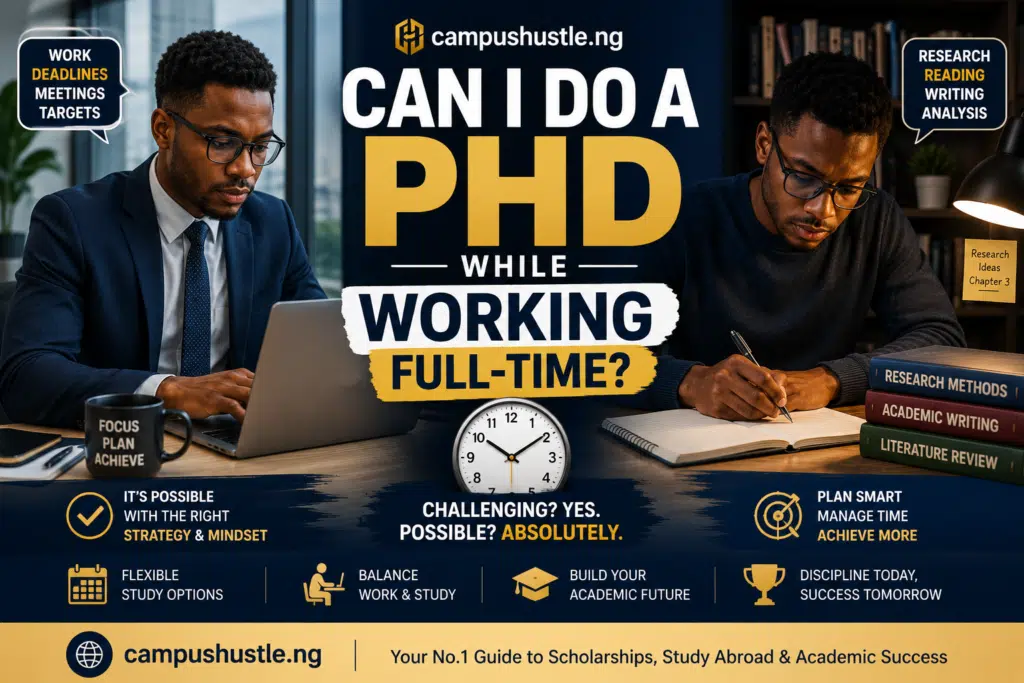
Can I Do a PhD While Working Full-Time? This question lands in our inbox more than almost any other.
“I have a job I cannot leave. My family depends on my income. I cannot pack up and move to the UK for 4 years. But I want a PhD. Is there any way?”
Short answer: Yes.
Longer answer: Yes, but you need to understand exactly what you are signing up for, because a part-time or distance PhD while working full-time is one of the hardest academic undertakings a person can commit to. Not because the research is harder than a full-time PhD (it is not, the intellectual work is the same). But because fitting PhD-level research around a full-time job, a Nigerian commute, work politics, family responsibilities, power cuts, and the general organised chaos of daily life in Nigeria requires a level of discipline, planning, and mental stamina that breaks many people who start the journey.
We are not saying this to discourage you. We are saying it because we want you to succeed, and success starts with clear-eyed preparation.
In this guide, we will cover everything Nigerian working professionals need to know about doing a PhD while employed full-time, the local options, the international options, the online options, the honest challenges, and the strategies that actually work.
READ ALSO: How to Find a PhD Supervisor Who Will Fund Your Research
Table of Contents
What Does “Part-Time PhD” Actually Mean?
Before we go further, let us define terms, because “part-time PhD” means different things in different contexts.
Part-Time PhD at a Nigerian University You are registered as a part-time PhD student at a Nigerian university. You attend seminars, meet your supervisor, and conduct your research while maintaining your employment. The duration is typically 4–6 years instead of the standard 3–4 years for full-time study.
Distance/Remote PhD at an International University You are registered at a foreign university but conduct most of your research remotely from Nigeria. You may travel to the host institution for specific periods (supervision meetings, laboratory work, examinations) but your base remains Nigeria.
Fully Online PhD You complete your entire PhD program through an online platform; no physical campus visits required. These are relatively rare at legitimate research universities and more common at some professional/applied doctorate programs.
Sandwich PhD (or Split-Site PhD) You are primarily registered at a Nigerian university but spend significant periods (typically 6–18 months total, in blocks) at an international university for research training and supervision. The DAAD Sandwich PhD is the most well-known example.
Each of these has different implications for your time, your funding, your career, and the prestige of the resulting degree.
Read Also: Commonwealth PhD Scholarships (for High Income Countries)
Part-Time PhD at Nigerian Universities
Let us start at home, because this is the most common route for Nigerian working professionals.
Most Nigerian universities (both federal and state) offer part-time PhD enrollment across many departments. This allows employed professionals to pursue doctoral studies without resigning from their jobs.
How it typically works:
- You apply as a part-time PhD student through the same postgraduate application process as full-time students
- You are assigned a supervisor (or you negotiate with a preferred supervisor in your department)
- You attend departmental seminars and supervision meetings, usually on evenings or weekends depending on the department
- You conduct your research independently around your work schedule
- Duration: typically 4–6 years for completion
- Fees: lower than international options, typically ₦200,000–₦800,000 per session depending on the university and faculty
The advantages:
- You keep your job and your income, no financial sacrifice
- You remain embedded in your professional network in Nigeria
- Your research can directly address problems you encounter in your work
- The thesis topic is often more immediately applicable to Nigerian contexts
The disadvantages — let us be honest:
- Nigerian PhD programs vary enormously in quality. Some are rigorous, internationally competitive, and produce strong graduates. Others are under-resourced, poorly supervised, and result in degrees that are not taken seriously internationally
- Supervision quality is inconsistent, some supervisors are excellent mentors who push you to publish and defend on time; others are unavailable, disengaged, or interested in your research only as a footnote to theirs
- Laboratory infrastructure at many Nigerian universities is inadequate for certain types of research, particularly in STEM fields requiring advanced equipment
- ASUU strikes can pause your program for months at a time, disrupting your research continuity and motivation
- The social pressure and the academic environment of a university campus (which keep full-time PhD students focused and intellectually stimulated) are absent when you are working in a non-academic environment
Who should choose this route: Nigerian academics (lecturers, assistant lecturers) who need a PhD for promotion within the Nigerian university system, and whose research is primarily library-based, theoretical, or field-based (not requiring expensive equipment). Also social science and humanities researchers whose primary data sources (communities, archives, policy documents) are in Nigeria.
How to choose the right Nigerian university: Research matters here. Look for:
- Departments with internationally published faculty (check Google Scholar)
- Departments that have graduated PhD students recently (not just admitted them)
- Supervisors who are actively researching and publishing, not just collecting supervision fees
- Universities with at least basic research infrastructure in your field
International Part-Time and Distance PhD Options
Several international universities (particularly in the UK) offer formal part-time PhD programs that allow students to be based in their home countries for most of the program, with periodic visits to the host institution.
UK Part-Time PhD Programs
The UK has a well-developed tradition of part-time doctoral study. Many Russell Group universities offer part-time PhD registration for students who cannot attend full-time, typically taking 6–8 years instead of 3–4.
How it works:
- You apply for part-time PhD registration at a UK university and are assigned a supervisor
- Most supervision happens remotely, via video call, email, and written feedback on your drafts
- You visit the UK campus for specific events, typically once or twice per year for supervision intensives, annual review panels, or workshops
- Your dissertation is submitted and examined by the same standards as full-time students
Cost: UK university fees for part-time PhDs for international students can range from £5,000 to £15,000 per year, making it significantly more expensive than a Nigerian program. Funding for part-time international students is limited, most UK scholarships require full-time study.
Who should consider this: Nigerian professionals who can self-fund (or whose employer sponsors their studies), who work in a field with strong UK academic connections, and who want an internationally recognised PhD without fully relocating.
University of South Africa (UNISA)
UNISA is one of the world’s largest distance learning universities, based in South Africa, and is fully accredited and internationally recognised. Their PhD programs are designed for distance learners, you are supervised remotely and submit your thesis without regular campus visits.
Advantages: Affordable (fees are lower than UK or Nigerian private universities), African institution, flexible timing, accredited degree.
Disadvantages: UNISA’s PhD is by dissertation only, there is very limited structured training or coursework. This requires exceptional self-direction. The quality of supervision varies significantly by department.
Who should consider this: Social science, humanities, education, and management researchers who are self-directed, disciplined, and already have strong research skills from their Masters.
Online PhD Programs (What is Legitimate?)
Let us address the elephant in the room: the internet is full of “online PhD programs” — many of which are outright scams or diploma mills that will give you a piece of paper worth nothing academically or professionally.
Signs of a legitimate online/distance PhD:
- The institution is accredited by a recognised national accreditation body (SAQA in South Africa, QAA in the UK, HLC/SACSCOC in the USA)
- The institution is listed in the UNESCO World Higher Education Database (WHED)
- The program requires an original research dissertation, not just coursework
- The degree is identical to the degree earned on-campus at the same institution
- The institution has been in existence for at least 10–20 years
- The degree is accepted by Nigerian employers and the NUC (National Universities Commission)
Signs of a diploma mill:
- Suspiciously fast completion (PhD in 6 months? Absolutely not)
- No research dissertation required
- Degrees awarded based on “life experience”
- The institution has a name that sounds like a prestigious university but is slightly different (“Oxford International University” — not the University of Oxford)
- They accept anyone who pays without any admission process
- The degree is not recognised by any employer you would actually want to work for
Some legitimate online/distance PhD options:
- UNISA (South Africa) — widely covered above
- University of Liverpool Online (UK) — specific professional doctorate programs
- Open University (UK) — research degrees with distance supervision
- Walden University (USA) — professional doctorates in education, business, health
Be very careful: Legitimate online PhDs take 4–8 years of serious research work. Anyone claiming otherwise is not offering a PhD worth having.
The DAAD Sandwich PhD — The Best of Both Worlds
This deserves special mention because it is specifically designed for the situation many Nigerian academics find themselves in — enrolled in a Nigerian PhD program but needing international research training and infrastructure to complete world-class research.
The DAAD Sandwich Model PhD allows you to:
- Remain enrolled as a PhD student at your Nigerian university
- Spend 12–24 months total (in blocks) at a German university or research institute for your research training and part of your laboratory or fieldwork
- Return to Nigeria to complete your thesis under your Nigerian supervisor
- Graduate from your Nigerian university with a Nigerian PhD — but one built on international-quality research experience
What DAAD covers during your time in Germany:
- Monthly stipend of approximately €934/month
- Travel allowance
- Health insurance
- German language course funding
Who this is for: Nigerian PhD students or lecturers who are already enrolled in a Nigerian PhD program and want to access German research infrastructure without relocating permanently.
READ ALSO: The DAAD Sandwich PhD Scholarship: How to Research in Germany While Studying in Nigeria (Full Guide)
The Honest Challenges of a PhD While Working Full-Time
Let us be real with you here, because most guides skip this part.
Time is the biggest enemy A PhD requires sustained, deep intellectual work. Writing literature reviews, analysing data, drafting and revising chapters, and engaging with complex theoretical frameworks are not tasks you can do effectively in 30-minute windows between meetings. You need blocks of uninterrupted time — typically 15–20 hours per week minimum to make reasonable progress.
Finding those hours while working full-time in Nigeria — with the commutes, the power cuts, the family obligations, the social demands — is genuinely hard. Possible, but hard.
The isolation problem Full-time PhD students benefit enormously from being around other PhD students — the intellectual stimulation, the peer support, the shared frustration, the collaborative problem-solving. When you are doing a PhD in isolation, working from home on evenings and weekends, the absence of this community is deeply felt.
The motivation curve Years 1–2 of a part-time PhD: exciting. Year 3: difficult. Year 4: crisis. Year 5: either you finish or you stop. This is the brutal reality of most part-time PhDs. The PhD that started as a personal ambition gradually becomes a source of guilt, shame, and exhaustion as it extends. Understanding this curve and having strategies to navigate it is essential.
Career distraction Your career does not pause while you do a PhD. Promotions happen, new projects arrive, your boss needs extra work done. Every career demand competes with your PhD time. Managing these competing priorities requires constant renegotiation — with your employer, your family, and yourself.
The supervisor relationship Part-time supervision is harder for both parties. Your supervisor has less regular contact with you, which means less visibility into your progress and less motivation to engage deeply with your work. You need to be more proactive about scheduling meetings, sending drafts, and keeping the relationship active.
Strategies That Actually Work
From Nigerian academics and working professionals who have successfully completed PhDs while employed, here is what consistently makes the difference:
Write a PhD schedule and treat it like a second job Block specific hours in your calendar every week — and protect them as aggressively as you would protect a work meeting with your CEO. “Writing mornings” (5 AM – 7 AM before work), “Saturday research days,” or “Thursday evening chapters” — whatever your schedule allows. The specific hours matter less than their consistency.
Choose a research topic close to your work If your research question is directly relevant to your professional work, you get double benefit from the same investment of time. A banker studying fintech regulation, a doctor studying clinical outcomes, a teacher studying curriculum design — these people can make progress because they are surrounded by their data, their subjects, and their context every day at work.
Join or create a writing group Find 3–5 other part-time PhD students — locally or online — and commit to weekly or fortnightly writing accountability sessions. Shared accountability dramatically reduces the isolation and the motivation drop-off of years 3 and 4.
Be strategic about your literature review The literature review is where many part-time PhD students get stuck — reading endlessly without writing. Set a hard limit: “I will write my literature review in 3 months and then move to data collection, regardless of whether I have read every paper in existence.” You can always go back and update.
Talk to your employer early Some Nigerian employers — particularly universities, research institutes, government agencies, and multinationals — actively support employees pursuing PhDs. Some offer study leave, flexible hours, or even fee sponsorship. You will not know unless you ask. Having your employer’s understanding — even informally — makes a significant difference to your ability to manage time.
Set a hard submission date and work backwards Pick a realistic target submission date — perhaps 4 or 5 years from now — and work backwards to quarterly milestones: literature review complete by Month 6, data collection complete by Month 18, first chapter draft by Month 24, and so on. Working to milestones rather than just “doing the PhD” creates structure and momentum.
READ ALSO: Get Your Scholarship Past Questions & Answers PDF
Is a Part-Time PhD Worth It? The Career Calculus
This is the question you need to answer honestly before you commit.
When a part-time PhD is clearly worth it:
For Nigerian academics — a PhD is not optional. Without one, promotion beyond Lecturer I is virtually impossible in the Nigerian university system. The NUC requires PhD holders for senior academic positions. If you are an academic, the calculus is clear: get the PhD.
For senior government or public sector professionals — a PhD is increasingly expected for director-level and above roles in some Nigerian government agencies and parastatals. The letters “Dr.” carry genuine professional weight in the Nigerian public sector.
For health professionals — Nigerian medical practitioners, pharmacists, and allied health professionals pursuing academic medicine or research careers need a PhD for research grants, academic promotion, and international credibility.
For researchers at Nigerian institutes — (NIMR, IITA, NISER, etc.) a PhD is essential for research independence, grant eligibility, and career progression.
When to be more cautious:
If you are in the private sector and already earning well, the salary uplift from a PhD may not justify 5+ years of evenings and weekends sacrificed. The opportunity cost — time you could spend building skills, advancing your career, or building a business — is real.
If your main motivation is prestige rather than genuine intellectual passion or career necessity, the grind of a 5-year part-time PhD will exhaust you before you reach the finish line.
Be honest with yourself about your “why” before you start.
FAQs
Can I do a PhD while working full-time at a Nigerian university? Yes — most Nigerian universities allow lecturers to enroll as part-time PhD students while maintaining their positions. This is actually the most common route for Nigerian academics. Confirm the specific policy and part-time registration process at your institution.
Can my employer pay for my PhD? Some Nigerian employers — particularly international companies, government agencies, and universities — have staff development budgets that can be used for PhD study. Approach your HR department or line manager with a specific proposal. Frame it in terms of the benefit to the organisation, not just your personal career advancement.
How long does a part-time PhD typically take in Nigeria? Officially: 4–6 years. In practice: many Nigerian part-time PhD students take 7–10 years. Setting a hard target of 5 years and working to quarterly milestones significantly improves completion rates.
Is a Nigerian PhD internationally recognised? It depends on the university and the quality of the research. A PhD from University of Ibadan, University of Lagos, ABU, OAU, or University of Nigeria with published research is internationally recognised and respected. A PhD from an obscure private university with minimal research output may not carry the same weight internationally.
Can I convert a part-time PhD to full-time registration? At most Nigerian universities, yes — if your circumstances change (e.g., you leave your job), you can request to change your registration status. Check the specific policy at your institution.
What is the difference between a PhD and a professional doctorate (DBA, EdD, DPH)? A PhD is a research degree, you make an original contribution to knowledge through a thesis. A professional doctorate (DBA — Doctor of Business Administration, EdD — Doctor of Education, DPH — Doctor of Public Health) is a practice-focused doctorate that typically requires both coursework and a shorter applied research project. Professional doctorates are becoming more common and are increasingly accepted in Nigerian academic and professional contexts, though they are not equivalent to a PhD for academic research careers.
READ ALSO: DAAD Sandwich PhD Scholarship: How to Research in Germany While Studying in Nigeria (Full Guide)
In Summary
A PhD while working full-time is possible. Thousands of Nigerian academics, doctors, researchers, and professionals have done it, and gone on to have better careers, deeper research impact, and genuine intellectual satisfaction as a result.
But it is not easy. And going in without clear eyes about the challenges (the time, the isolation, the motivation curve, the years of sacrificed evenings and weekends) is the most common reason people start a part-time PhD and never finish.
The students and professionals who complete them share a few things in common: they chose a research topic they genuinely cared about, they built discipline into their schedule early, they sought community and accountability, and they committed to a hard finish date.
If you are a Nigerian academic who needs a PhD for promotion, the DAAD Sandwich model is worth serious consideration, it gives you international research experience while letting you maintain your position and your Nigerian enrollment.
If you are a working professional exploring a local or distance program, choose your institution and supervisor carefully, the quality of the supervision and the research environment will define whether you finish and whether the degree serves you afterwards.
The PhD is worth pursuing. Start with clarity about your why, your timeline, and your strategy.
Are you currently doing a part-time PhD or considering one? Drop your situation in the comments (field, institution, and biggest challenge) and let us know how we can help.
Disclaimer: PhD program structures, part-time enrollment policies, and international recognition vary by institution and country. Always verify specific requirements with your target institution. Campus Hustle Nigeria does not charge for guidance and is not affiliated with any institution mentioned in this article.