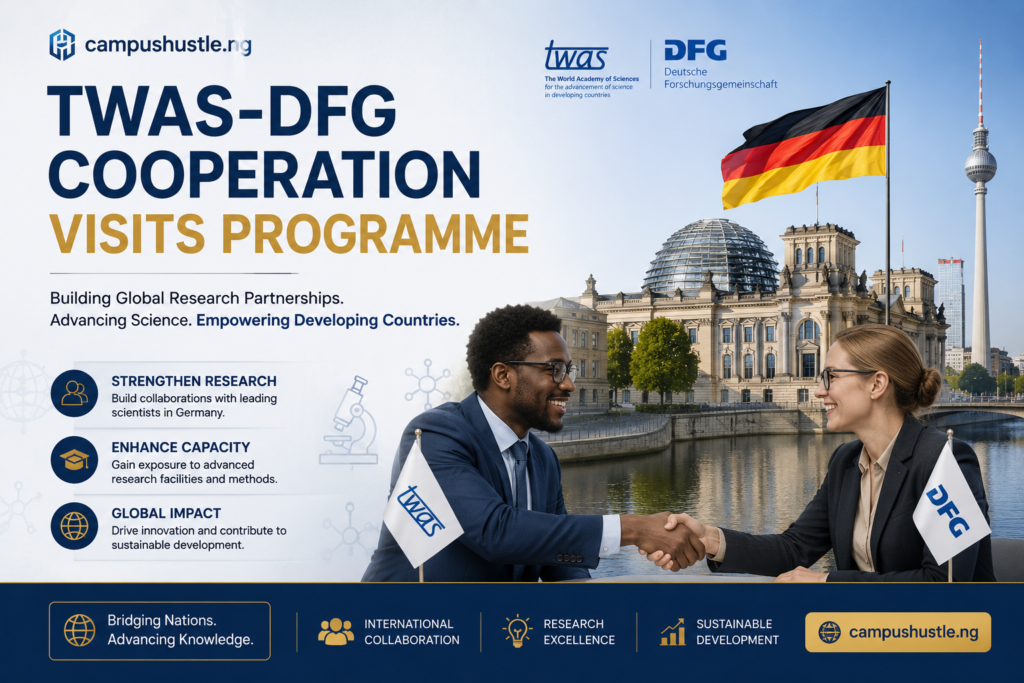
Most Nigerian researchers have heard of TWAS. Far fewer have heard of the TWAS-DFG Cooperation Visits Programme, and that is a missed opportunity worth correcting today.
If you are a Nigerian researcher (a PhD student, postdoctoral fellow, or early-career academic) who wants to spend time conducting collaborative research at a German university or research institute, the TWAS-DFG programme is one of the most direct, most accessible, and least-competed-for opportunities available to you.
It does not require you to leave your PhD program. It does not require you to give up your current position. It funds a research visit of 2 to 3 months to a German institution, with travel, accommodation, and a living allowance all covered.
Think of it as a research exchange. You go to Germany, work with a German researcher on a collaborative project, bring new skills and connections back to Nigeria, and return stronger academically than when you left.
In this guide, we break down everything Nigerian researchers need to know about the TWAS-DFG Cooperation Visits Programme, what it is, who qualifies, how to apply, and how to make the most of the opportunity.
READ ALSO: How to Get a PhD in Germany for Free — Nigerian Guide
Table of Contents
What is the TWAS-DFG Cooperation Visits Programme?
The TWAS-DFG Cooperation Visits Programme is a joint fellowship initiative between:
- TWAS (The World Academy of Sciences), an international science academy headquartered in Trieste, Italy, that promotes scientific excellence and capacity building in the developing world. Nigeria has TWAS Fellows, Nigerian scientists elected to the Academy based on their research excellence.
- DFG (Deutsche Forschungsgemeinschaft), the German Research Foundation, Germany’s central funding organisation for academic research. The DFG funds research projects at German universities and research institutes and is one of the most prestigious research funding bodies in the world.
The programme funds researchers from TWAS member states in the developing world (including Nigeria) to visit German research institutions for short-term collaborative research stays.
The key word here is collaborative. This is not a scholarship to do your own independent research at a German institution. It is a funded visit to work alongside a specific German researcher on a project of mutual interest. The research connection between the Nigerian applicant and their German host is the foundation of the whole programme.
Important: Always verify current programme details, eligibility criteria, and deadlines at the official TWAS website: twas.org. Programme details are updated annually.
What Does the Programme Cover?
The TWAS-DFG Cooperation Visits Programme covers the following:
Return Economy Class Airfare Your round-trip flight from Nigeria to Germany and back is covered. The DFG arranges or reimburses this, the specific mechanism depends on the current programme guidelines.
Monthly Living Allowance You receive a monthly living allowance during your stay in Germany. The amount is calibrated to cover basic accommodation and living costs in Germany. At recent programme rates, this has been approximately €2,000 per month, sufficient for comfortable but modest living in most German university cities.
Health Insurance Basic health and accident insurance coverage for the duration of your visit.
What is NOT covered: Research consumables and laboratory costs are generally the responsibility of your German host institution. Personal travel within Germany beyond the research visit, family members, and expenses beyond the living allowance are not covered.
Duration: The visit is typically 2 to 3 months, long enough to conduct meaningful collaborative research, establish a genuine working relationship, and collect data or conduct experiments, but short enough that you can return to your home institution without disrupting your ongoing work significantly.
Who is Eligible? (The Real Requirements)
This is where many Nigerian researchers self-disqualify unnecessarily, or waste time applying when they do not meet the criteria. Read carefully.
Citizenship and Residency You must be a citizen of a TWAS member state from the developing world. Nigeria is a TWAS member state. You must be currently working and residing in Nigeria, not already based in Germany or another developed country.
Academic and Research Position You must be employed at or affiliated with a research institution or university in Nigeria at the time of application. This includes:
- Lecturers, Senior Lecturers, Associate Professors, or Professors at Nigerian universities
- Researchers at Nigerian government research institutes (e.g., NIMR, NISER, IITA, NAFDAC research units, NCDC, FIIRO, etc.)
- PhD students enrolled at Nigerian universities (with the support of their Nigerian supervisor)
- Postdoctoral researchers affiliated with Nigerian institutions
Fresh graduates with no institutional affiliation are generally not eligible.
Research Track Record While the TWAS-DFG is accessible for earlier-career researchers than the Humboldt Fellowship (which requires a completed PhD and an established publication record), you still need to demonstrate that you are an active researcher. This means:
- At least some publications in peer-reviewed journals or conference proceedings
- An ongoing research project that your proposed German visit will contribute to
- A genuine research plan for the 2–3 month visit
A German Research Host You must identify and confirm a German researcher who agrees to host you at their institution for the visit. This is non-negotiable, without a German host, there is no application.
English Language Your application and your research visit will be conducted in English. Strong English writing ability is essential for a competitive application.
What is the DFG? (And Why It Matters)
We briefly introduced the DFG above, but let us give it proper context, because understanding the DFG helps you identify the right German hosts and write a stronger application.
The Deutsche Forschungsgemeinschaft (DFG) funds research projects at German universities through competitive grants. When a German professor receives a DFG grant, it means their research has been peer-reviewed and approved as scientifically excellent by a national committee of experts.
DFG-funded researchers are:
- Actively working on funded projects with resources to support collaboration
- Already embedded in Germany’s top research culture
- Familiar with the process of hosting international visitors
- Often actively looking for international collaborators to strengthen their research network
This is why searching for DFG-funded researchers in your field is one of the smartest strategies for finding the right German host for your TWAS-DFG visit. A DFG-funded professor has the resources, the mandate, and the infrastructure to genuinely benefit from your visit.
How to find DFG-funded researchers: Visit gepris.dfg.de, the DFG’s public database of funded projects. Search by your field keywords, browse current funded projects, identify the lead researchers, and check their institutional affiliation. Then visit their university department page to read their full research profile before making contact.
How to Find a German Research Host
Finding the right German host is the most critical step, and the one that takes the most time. Start this process well before you plan to submit your application.
Step 1: Define your collaborative research topic What specific research will you and your German host work on together? This cannot be vague. “We will collaborate on sustainable agriculture” is not a collaborative research plan. “We will conduct comparative analysis of cassava drought tolerance biomarkers using molecular markers developed at Prof. [Name]’s lab at the University of Bonn, integrating field data from three Nigerian States” is a collaborative research plan.
Your proposed research must:
- Build on your existing research in Nigeria
- Connect specifically to what your German host is already working on
- Be achievable in 2–3 months
- Produce a tangible output (data collected, paper drafted, methodology tested, etc.)
Step 2: Search for German researchers in your area
- Google Scholar: Your research keywords + German universities
- ResearchGate: German researchers with profiles in your field
- DFG Gepris database: Funded projects in your field
- DAAD partner university databases
- Previous TWAS-DFG grantee lists (sometimes available on the TWAS website or in TWAS newsletters)
Step 3: Read and understand their work Before any contact, read at least 2–3 recent publications from your potential host. Understand what they are doing, what data or methods they use, and where your research creates a genuine overlap.
Step 4: Write a professional contact email Your email to the German researcher should be:
- Subject: “Research Collaboration Inquiry — TWAS-DFG Cooperation Visits Programme”
- Paragraph 1: Who you are, your position, your institution, your research area
- Paragraph 2: A specific reference to their work — show you have read it
- Paragraph 3: Your proposed collaborative research plan — specific and relevant to both of you
- Paragraph 4: The TWAS-DFG programme — briefly explain it (some German researchers may not know it) and ask if they would be willing to serve as your host
- Close: Offer to send your CV, publications list, and a more detailed research proposal
- Keep it under 400 words
Step 5: Formalise the host agreement If the German researcher agrees, they need to provide a formal letter of support/invitation for your application. Work with them on this — it should specifically describe the collaborative research you will conduct, the facilities available at their institution, and why the visit will benefit both parties.
How to Apply: Step-by-Step
Step 1: Confirm eligibility and gather information Visit twas.org and navigate to the TWAS-DFG Cooperation Visits Programme page. Read the current programme guidelines carefully. Confirm that Nigeria is on the eligible country list for the current cycle and note the application deadline.
Step 2: Secure your German host and their invitation letter As described above — this is done before you start the formal application.
Step 3: Gather your application documents
The TWAS-DFG application typically requires:
- Completed application form (from the TWAS website)
- Research visit plan / research proposal (the main essay — more below)
- Full CV including complete list of publications
- Invitation/support letter from your German host
- Two reference letters from established researchers (your PhD supervisor, department head, or senior colleagues who know your research work)
- Proof of your current position at your Nigerian institution (employment letter or enrollment confirmation)
- Copies of your academic degrees (PhD certificate if completed, Masters certificate)
- Selected reprints of your most important publications (typically 2–3)
- Copy of valid passport
Step 4: Submit your application Applications are submitted through the TWAS online portal or by email/post as specified in the current guidelines. Check the current submission process at twas.org.
Step 5: Wait for review and results TWAS reviews applications and announces results typically within 3–6 months of the deadline. Successful applicants receive a formal award letter from TWAS, after which they begin visa and travel preparations.
Step 6: German Research Visa As a TWAS-DFG fellow, you will need a German research visa. Contact the German Embassy or Consulate in Nigeria with your TWAS award letter, invitation from your host, and other required documents. Allow 4–8 weeks for visa processing.
How to Write a Winning TWAS-DFG Application
The research visit plan is the heart of your application. Unlike a general scholarship essay, the TWAS-DFG application is focused almost entirely on the scientific merit of the proposed collaboration. Here is how to structure it:
Title
A clear, descriptive title for the collaborative research project.
Background and Context (20–25% of proposal)
Briefly establish the scientific context of your research area. What is already known? What gap exists? How does your current research in Nigeria contribute to addressing this gap? Cite key literature including your own publications where relevant.
Rationale for the Collaborative Visit (15–20% of proposal)
Why does this collaboration require a physical visit to Germany? What does the German host institution offer — specific equipment, datasets, methodologies, expertise — that is not available in Nigeria and is essential for the proposed research?
This section is critical. The reviewers need to see that the visit is genuinely necessary for the research — not just a convenient way to travel to Germany.
Research Plan for the Visit (30–35% of proposal)
What exactly will you do during the 2–3 months in Germany? Be specific:
- Month 1: What experiments, data collection, or analysis will you conduct?
- Month 2: What will you complete or begin?
- Month 3: What will you finalise and prepare for publication?
The plan should be realistic — achievable in 2–3 months — and should produce a clear output (data, a manuscript draft, a new protocol).
Expected Outcomes (15% of proposal)
What will you take back to Nigeria from this visit? This should include:
- Scientific outcomes: data, results, a co-authored paper
- Capacity outcomes: new skills, techniques, or methodologies you will be able to apply in Nigeria
- Collaboration outcomes: a strengthened research partnership with your German host that outlasts the visit
Long-Term Impact (10–15% of proposal)
How will this visit contribute to your broader research programme and to scientific capacity in Nigeria? How does this collaboration fit into your longer-term academic or research career?
Making the Most of Your Research Visit
If you win the TWAS-DFG fellowship and travel to Germany, here is how to make the 2–3 months genuinely transformative:
Be Productive From Day One You have a short window. Come with a clear plan of what you need to do each week. Agree with your German host before arrival on specific milestones — what you will have accomplished by the end of week 2, week 4, week 8.
Attend Seminars and Group Meetings Your host’s research group will have regular meetings, seminars, and journal clubs. Attend all of them. This is how you build relationships with other German researchers in your field — relationships that can lead to future collaborations, co-authored papers, and invitations to conferences.
Network Beyond Your Host Germany has multiple research groups in every active field. Use your time in Germany to attend public lectures, visit neighbouring institutes, and meet researchers beyond your immediate host. The German academic community is welcoming to visiting international researchers.
Document Everything Keep detailed research notes. Collect all the data you can. Photograph protocols, equipment setups, and key procedures. The knowledge you bring back to Nigeria should be usable at your home institution.
Begin the Next Application During your visit, discuss with your German host whether the collaboration can continue — through a DAAD research grant, a joint paper, a Humboldt fellowship application, or another mechanism. The best outcome of a TWAS-DFG visit is a long-term Nigeria-Germany research partnership.
READ ALSO: Humboldt Research Fellowship: How to Apply as a Nigerian Scholar
FAQs
Is the TWAS-DFG programme for PhD students or only for established researchers? Both. PhD students enrolled at Nigerian universities can apply, provided they have institutional support from their Nigerian supervisor and can demonstrate an active research project. Early-career postdocs and lecturers are also eligible. The programme covers a range of career stages.
How competitive is the TWAS-DFG programme? It is competitive but less so than flagship scholarships like the Humboldt or DAAD full fellowships. Because the visits are short-term (2–3 months) and focused on collaborative research rather than degree completion, the applicant pool is smaller. A strong research proposal with a credible German host significantly improves your chances.
Can I apply for the TWAS-DFG programme while also applying for a full PhD or postdoc scholarship in Germany? Yes. These are different programme types — one is a short research visit, the others are longer-term awards. Applying simultaneously is reasonable. However, you cannot hold both simultaneously during the same period.
Do I need to pay the semester fee at the German university during my visit? Typically no — as a research visitor (not a enrolled student), you are not registered as a student and do not pay semester fees. Your host institution handles your administrative registration as a visiting researcher.
What if my German host does not know about the TWAS-DFG programme? This happens. Briefly explain it in your email — tell them it is a funded research visit programme where TWAS covers your travel and living costs, and the DFG collaborates to facilitate the visit. All they need to provide is a letter of support and access to their facilities. Most German researchers are receptive once they understand the programme.
Can the visit be extended beyond 3 months? The TWAS-DFG programme covers 2–3 months. Extensions are not normally part of the programme. However, after a successful visit, you may independently apply for additional funding (DAAD short-term research grants, for example) to extend your stay or return for a follow-up visit.
READ ALSO: Get Your Scholarship Past Questions & Answers PDF
In Summary
The TWAS-DFG Cooperation Visits Programme is one of the most practical, most accessible, and most underused opportunities for Nigerian researchers who want to build international research collaborations without leaving their current position permanently.
Two to three months in Germany (working in a world-class research environment, building relationships with German academics, accessing equipment and data unavailable in Nigeria) can permanently change the trajectory of your research career.
The key requirements:
- An active research position in Nigeria
- A specific collaborative research plan
- A willing German host researcher
- A publication record (even a modest one) demonstrating you are an active researcher
If you meet those requirements, the TWAS-DFG visit is within reach.
Start by finding your German host. Everything else follows from that.
Are you a Nigerian researcher interested in the TWAS-DFG programme? Drop your research field in the comments and let us know — we can help identify potential German host institutions.
Disclaimer: The TWAS-DFG programme details, coverage amounts, eligibility criteria, and deadlines change annually. Always verify current information at twas.org and dfg.de before applying. Campus Hustle Nigeria is not affiliated with TWAS or the DFG and does not charge for guidance.